
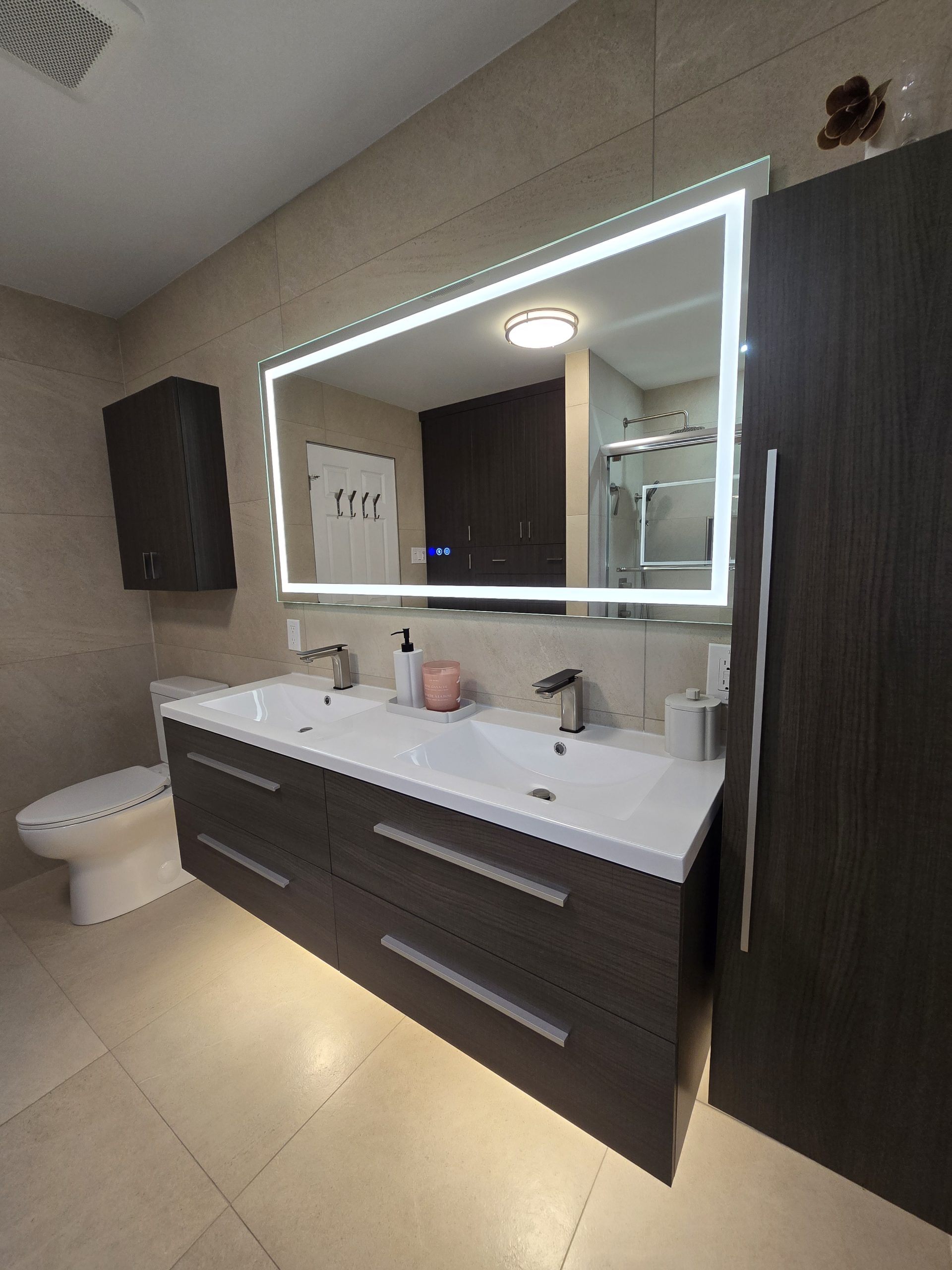

When homeowners plan a complete bathroom renovation, attention naturally goes toward the visible improvements. New tile, a modern vanity, better flooring, an upgraded shower, fresh lighting, new plumbing fixtures, and additional storage can completely transform an outdated room.
Ventilation is much easier to overlook because most of the system is hidden.
Yet proper ventilation can be one of the most important parts of a successful bathroom remodel.
Bathrooms regularly produce large amounts of moisture through showers and baths. Without an effective way to remove that humid air, moisture can linger on mirrors, walls, ceilings, cabinetry, grout, and other surfaces. Over time, excess moisture can contribute to deterioration and conditions that encourage mould growth.
For homeowners planning bathroom renovations in Chelsea QC, a complete remodel provides an ideal opportunity to evaluate the existing ventilation rather than simply reinstalling an old fan and assuming it is adequate.
At Girnet Contracting, we believe the systems behind a renovated bathroom deserve just as much attention as the finishes homeowners see every day. A beautiful bathroom should also be designed to manage moisture effectively and remain comfortable and durable for years.
Why Bathrooms Need Dedicated Ventilation
Every hot shower releases moisture into the bathroom air.
You can often see the immediate effects:
mirrors fog up, windows collect condensation, walls feel damp, and the room remains humid after someone finishes showering.
Some moisture eventually disappears, but where it goes matters.
Without adequate ventilation, moisture can remain in the room or migrate into surrounding materials and spaces.
Mechanical ventilation helps remove humid bathroom air at its source. The Government of Québec identifies bathroom exhaust as an important part of residential ventilation because showers and baths contribute to excess indoor humidity. Gouvernement du Québec
For a renovated bathroom, ventilation therefore should not be treated as an optional finishing detail.
It is part of the room’s moisture-management strategy.
Why a Complete Remodel Is the Right Time to Address Ventilation
Replacing an exhaust fan after a bathroom has already been completed may be possible, but a full renovation creates much greater flexibility.
During remodeling, ceilings or walls may already be open.
Electrical work may already be underway.
Lighting locations may be changing.
The shower may be relocated or enlarged.
Insulation and wall construction may be accessible.
This creates an opportunity to assess not only the fan itself but also the ductwork, exterior termination, controls, and fan location.
Instead of designing around an inadequate existing system, ventilation can be incorporated into the renovation from the beginning.
An Old Fan May No Longer Be Performing Properly
An exhaust fan can still make noise without removing moisture effectively.
That distinction is important.
Some homeowners hear their old bathroom fan running and assume everything is working properly.
However, actual performance can be affected by the condition of the fan, duct restrictions, installation quality, dirt accumulation, or other problems.
An older fan should therefore be evaluated during a complete bathroom renovation rather than automatically being reused.
If the rest of the bathroom is receiving a major upgrade, it often makes sense to determine whether the ventilation system also needs improvement.
Look for Warning Signs Before Renovation Begins
An existing bathroom may already be showing clues that moisture is not being managed properly.
These can include recurring condensation, peeling paint, persistent musty odours, staining, damaged finishes, or mould appearing repeatedly in damp areas.
Health Canada identifies high humidity, condensation, mould, lingering odours, and stuffiness as signs that ventilation may be insufficient. Canada
These symptoms should not simply be hidden behind new paint and tile.
A complete renovation provides an opportunity to investigate why they are happening.
Don’t Cover Moisture Damage With New Finishes
Imagine removing an older vanity and finding swelling or deterioration near the wall.
Or demolition around the shower reveals damaged material behind the tile.
The correct response is not simply to install new finishes over the affected area.
The source of the moisture needs to be understood.
Sometimes the issue may be a plumbing leak.
Sometimes waterproofing may have failed.
Sometimes persistent bathroom humidity may be contributing to the problem.
A quality remodel addresses the cause before rebuilding the surface.
Ventilation and Waterproofing Have Different Jobs
Bathroom ventilation and waterproofing are both essential, but they solve different problems.
Waterproofing protects wet areas from direct water exposure.
Ventilation helps remove excess moisture from the bathroom air.
One does not replace the other.
A perfectly waterproofed shower can still exist in a bathroom with excessive humidity.
Likewise, an excellent exhaust fan cannot compensate for improperly waterproofed shower walls.
A complete renovation needs both systems working together.
Ventilation Helps Protect New Paint
Bathroom ceilings and upper walls can receive significant moisture exposure.
Without adequate ventilation, condensation may repeatedly form on painted surfaces.
Over time, this can contribute to discoloration, peeling, bubbling, or deterioration.
Homeowners often invest considerable effort choosing the perfect bathroom paint colour.
Protecting that finish requires managing the environment around it.
Proper ventilation helps the new paint remain part of a finished bathroom rather than becoming an early maintenance problem.
Protecting New Cabinetry
A new vanity is often one of the largest investments in a bathroom remodel.
Cabinetry needs to deal with normal bathroom humidity, but persistent excessive moisture can be much harder on materials.
Doors, drawer fronts, cabinet boxes, and finishes all benefit from a bathroom environment where moisture is properly controlled.
Good ventilation therefore supports more than air quality.
It helps protect the renovation itself.
Protecting Trim and Millwork
Some bathroom designs include decorative trim, custom cabinetry, wood shelving, window casing, or other detailed finishing work.
These elements can add warmth and architectural character.
However, wood-based products generally perform better when the room is not repeatedly left saturated with moisture.
If Chelsea homeowners are adding detailed carpentry during a bathroom renovation, moisture management deserves additional attention.
Protecting Tile and Grout
Tile itself handles moisture extremely well when selected and installed appropriately.
But the complete tiled system includes grout, sealants, corners, joints, substrates, and surrounding materials.
Good ventilation helps the bathroom dry more efficiently after showers and baths.
That reduces the amount of time surfaces remain damp.
Health Canada specifically recommends using bathroom exhaust fans during bathing or showering and keeping them running afterward as part of controlling bathroom moisture. Canada
Ventilation Matters Even More With Large Showers
Modern bathroom renovations frequently replace small tub-and-shower combinations with larger walk-in showers.
That can significantly improve comfort and appearance.
But a large shower can also introduce substantial moisture into the room.
Multiple users taking showers one after another can create an especially humid environment.
If the bathing area is becoming larger during renovation, ventilation should be reconsidered at the same time.
The system that served the previous bathroom may not necessarily be the best solution for the renovated one.
Freestanding Tubs Still Produce Humidity
Removing the shower from the bathtub does not eliminate moisture concerns.
A deep bath can still release significant moisture into the room.
If a remodel includes both a large shower and a freestanding tub, ventilation becomes part of supporting the entire bathing environment.
The fan should therefore be planned around how the renovated bathroom will actually be used.
Bathroom Size Matters
A small powder room and a large primary bathroom do not necessarily have the same ventilation needs.
A larger bathroom may contain:
a walk-in shower, bathtub, double vanity, enclosed toilet area, and other features.
Room dimensions and moisture-producing fixtures need to be considered when selecting and designing ventilation.
Simply purchasing a fan because it appears powerful enough is not the same as properly planning the system.
Fan Capacity Should Match the Bathroom
Bathroom exhaust fans are available with different airflow capacities.
Choosing an appropriate fan depends on factors such as room dimensions, bathroom configuration, ductwork, and moisture sources.
A fan that is too weak may struggle to clear humidity effectively.
But selecting the highest-capacity fan available without considering the rest of the house is not necessarily the correct approach either.
Ventilation needs to be designed as a system.
Health Canada notes that residential ventilation decisions depend on factors including the home, occupants, airtightness, equipment, and ducting. Canada
Bigger Is Not Automatically Better
Homeowners sometimes assume that installing an extremely powerful exhaust fan is the safest option.
Residential ventilation is more complicated than that.
Exhaust fans remove indoor air, and replacement air has to enter the house from somewhere.
A poorly considered high-capacity exhaust system can affect pressure relationships within a home.
This is one reason fan selection should be based on the actual bathroom and home rather than simply choosing the largest model.
Ductwork Is Just as Important as the Fan
A high-quality exhaust fan cannot perform properly if connected to poorly designed ductwork.
Air needs a suitable path from the bathroom to the exterior.
Duct size, length, restrictions, turns, installation quality, and termination can all influence performance.
During a complete remodel, existing ductwork should therefore be considered alongside the fan.
Replacing only the visible fan may leave the real limitation untouched.
The Fan Should Exhaust Outdoors
Bathroom moisture should not simply be moved into another part of the house.
Health Canada recommends checking that bathroom exhaust fans vent outdoors rather than into an attic. Canada
This is an important detail during renovation.
If demolition provides access to the existing duct, homeowners can have the exhaust route assessed before the ceiling is closed again.
A renovated bathroom should not send warm, moist air into an area where it can create another moisture problem.
Pay Attention to the Exhaust Route
The most convenient-looking route is not always the most effective.
Long duct runs and unnecessary bends can increase resistance to airflow.
A complete renovation can provide an opportunity to evaluate whether the current route makes sense.
In some situations, improving the duct path may be just as valuable as upgrading the fan.
The goal is not merely to install equipment.
The goal is to move humid air effectively from the bathroom to the outdoors.
Duct Connections Matter
Hidden duct connections should be properly installed.
Air leaking into wall or ceiling cavities reduces the effectiveness of the system and may introduce moisture where it is not wanted.
These details disappear once drywall and finishes are installed.
That is why they should receive attention during the rough-in stage of a complete remodel.
Cold-Climate Conditions Need Consideration
Chelsea experiences cold winters, which makes ventilation planning particularly important.
Warm bathroom air contains moisture.
As that air moves through colder areas of the building, condensation can become a concern if ductwork and installation details are not appropriate.
A professional renovation should consider the entire exhaust route rather than focusing only on the ceiling grille.
Fan Location Can Affect Performance
The exhaust fan should be positioned strategically within the bathroom.
A fan installed far from the main source of humidity may not perform as effectively as one incorporated into the layout with moisture removal in mind.
This becomes especially important when remodeling changes the location of the shower or bathtub.
If the old shower was on one side of the bathroom and the new walk-in shower moves elsewhere, blindly leaving ventilation in the original location may not be the best design.
Coordinate the Fan With the New Shower
Bathroom renovations involve many ceiling elements.
There may be:
recessed lighting, shower lighting, decorative fixtures, speakers, ventilation grilles, and sometimes heating components.
These elements should be coordinated before construction is finished.
The fan location needs to work technically while also fitting neatly into the ceiling design.
Early planning usually produces a cleaner result.
Quiet Fans Can Encourage Better Use
Noise matters more than homeowners sometimes expect.
If a bathroom fan is irritatingly loud, people may switch it off as quickly as possible.
A quieter fan is less intrusive and therefore easier to leave operating when needed.
Health Canada specifically notes that quieter fans can encourage longer use compared with old, noisy equipment. Canada
This makes noise level an important practical consideration during a remodel.
A Bathroom Fan Doesn’t Need to Sound Powerful to Work Well
Homeowners sometimes associate loud equipment with strong performance.
Modern ventilation equipment can challenge that assumption.
A fan can move air effectively without dominating the room acoustically.
This is particularly valuable in an ensuite bathroom beside a bedroom.
A quiet system can operate without making the renovated bathroom feel noisy or mechanical.
Consider the Ensuite Experience
Ventilation deserves extra thought in primary ensuites.
Imagine one person showering early while another is sleeping nearby.
A loud fan can be disruptive.
A quiet, properly planned system can remove moisture while preserving the peaceful atmosphere homeowners often want from an ensuite.
Comfort is not only about tile and heated floors.
Sound is part of the experience too.
Controls Are an Important Part of Ventilation
Even an excellent fan provides little benefit if nobody turns it on or if it is switched off too early.
Controls can therefore make a meaningful difference.
Depending on the ventilation design, homeowners may consider:
timers, dedicated switches, automated controls, or humidity-responsive options.
The goal is to make proper operation convenient.
A complete remodel is the ideal time to decide how the ventilation system should be controlled because electrical work is already being planned.
Timers Can Simplify Everyday Use
A timer allows the fan to continue operating after someone leaves the bathroom.
This can be especially useful because humidity often remains after the shower itself is finished.
Health Canada recommends keeping a bathroom exhaust fan operating for at least 30 minutes after a shower or bath as part of moisture control. Canada
A timer can make this much easier than expecting everyone in the household to remember to return later and switch the fan off.
Humidity Controls Can Add Convenience
Some ventilation systems can respond automatically when bathroom humidity rises.
This can be useful in busy households where several people use the same bathroom.
Automatic operation can reduce reliance on memory.
However, the control still needs to be appropriate for the ventilation design and installed correctly.
Technology is most useful when it simplifies everyday behaviour.
Think About Who Uses the Bathroom
A guest bathroom may have different ventilation habits than a private ensuite.
Guests may not know which switch controls the fan.
Children may forget to use it.
Teenagers may take longer showers.
Several family members may use the bathroom consecutively in the morning.
Ventilation should be designed around these real behaviours rather than an ideal scenario in which everyone operates equipment perfectly.
Morning Routines Can Create Significant Humidity
In a busy household, one shower may immediately follow another.
The room may never have time to dry completely between users.
This is where ventilation performance becomes especially noticeable.
A properly designed system helps remove accumulated moisture instead of allowing the bathroom to remain damp throughout the morning.
Don’t Depend Entirely on Opening a Window
A bathroom window is valuable.
It provides daylight and can sometimes provide additional airflow.
But it should not automatically be treated as a substitute for mechanical ventilation.
During a Chelsea winter, opening a window after every shower is unlikely to be a comfortable or consistent strategy.
Health Canada also notes that natural ventilation through windows can be difficult to control and can contribute to energy loss depending on outdoor conditions. Canada
Mechanical ventilation provides a more predictable approach.
Protect Window Areas From Moisture Too
If a window is located near the bathtub or shower, the renovation should consider moisture exposure around the opening.
Window trim, sill materials, waterproofing details, and surrounding tile all need appropriate planning.
Ventilation helps reduce overall humidity, but surfaces exposed directly to water still need proper construction.
Again, different moisture-control strategies work together.
Better Ventilation Can Help Mirrors Clear Faster
A constantly fogged mirror is one of the most visible signs of bathroom humidity.
Some temporary condensation after a hot shower is normal, but a room that remains saturated for an extended period may benefit from better moisture removal.
Improved ventilation can help the bathroom return to comfortable conditions more efficiently.
That makes the room easier for the next person to use.
It Can Improve Everyday Comfort
High humidity can make a bathroom feel stuffy even after the shower is finished.
Removing moist air helps the room return to normal conditions.
This is particularly useful when several people need the bathroom one after another.
Ventilation is therefore not simply about protecting building materials.
It also contributes directly to everyday comfort.
Ventilation Helps Manage Odours
Bathroom exhaust systems also help remove unwanted odours.
This can be particularly useful in bathrooms located near bedrooms, hallways, or living spaces.
A renovated bathroom should feel fresh as well as look clean.
Effective air removal supports both goals.
Think About Air Movement Under the Door
For air to leave through an exhaust fan, replacement air needs a way to enter the room.
This is part of why bathroom ventilation should be considered as a complete system rather than as an isolated appliance.
Door clearances, home ventilation design, and other factors can influence airflow.
A qualified professional can consider these relationships when planning the renovation.
A More Airtight Home Changes the Equation
Older homes sometimes relied heavily on uncontrolled air leakage.
Renovated homes may become tighter as windows, insulation, air sealing, and other components improve.
As natural leakage decreases, deliberate mechanical ventilation becomes increasingly important.
Health Canada notes that modern Canadian homes are generally more airtight than older homes and therefore depend more heavily on mechanical ventilation for indoor air quality. Canada
Bathroom remodeling should be considered within that broader context.
Consider the Home’s Existing Ventilation System
Some Chelsea homes may already have a heat recovery ventilator or another whole-home ventilation system.
The bathroom renovation should take the existing system into account.
It may not always make sense to treat the bathroom as completely independent from the rest of the home’s ventilation.
The existing setup, bathroom exhaust arrangement, and planned renovation need to be assessed together.
Understand the Role of an HRV
A heat recovery ventilator can exchange stale indoor air with outdoor air while recovering some of the heat from the outgoing air.
This is especially relevant in colder climates.
The Government of Québec notes that HRVs are commonly used as part of residential ventilation, with air often extracted from moisture-producing areas such as bathrooms. Gouvernement du Québec
Whether a bathroom should connect to a larger system or use a separate exhaust fan depends on the home and system design.
Don’t Make Major Ventilation Changes in Isolation
A bathroom renovation may seem like a small part of the house, but ventilation interacts with the building as a whole.
Changes to exhaust capacity can affect airflow and pressure.
For this reason, substantial changes should be evaluated appropriately rather than improvised.
The objective is a bathroom that works well without creating unintended issues elsewhere.
Coordinate Ventilation With Electrical Work
A complete remodel often includes new lighting, switches, receptacles, heated floors, illuminated mirrors, and other electrical upgrades.
The ventilation system belongs in this planning phase.
Fan wiring, controls, timers, sensors, and lighting combinations should be decided before the walls and ceiling are closed.
This creates a cleaner installation and reduces the need for later modifications.
Decide Whether Fan and Light Controls Should Be Separate
Some older bathrooms connect the fan and light to the same switch.
That guarantees the fan operates whenever the light is on, but it may not always provide the flexibility homeowners want.
Other bathrooms use separate controls.
The best arrangement depends on how the room is used and how ventilation needs to operate.
A remodel gives homeowners an opportunity to reconsider an inconvenient existing setup.
Coordinate Ventilation With Heated Flooring
Heated flooring makes a Chelsea bathroom much more comfortable during colder months.
But warm floors do not replace ventilation.
Heating may make surfaces feel comfortable, while moisture still needs an effective path out of the room.
Both systems address different aspects of bathroom comfort.
Coordinate Ventilation With New Cabinetry
If the renovation introduces full-height cabinets or additional storage, airflow and fan placement should still make sense.
Cabinetry should not interfere with grilles or create awkward ceiling arrangements.
Planning the room as one complete system prevents individual upgrades from conflicting with one another.
Coordinate Ventilation With Lighting
A ceiling filled with randomly placed components can undermine an otherwise carefully designed bathroom.
Fan grilles and recessed lights should be positioned deliberately.
Symmetry may matter in some rooms.
In others, functional placement should take priority.
The important point is that both lighting and ventilation are designed before installation rather than treated as separate afterthoughts.
Don’t Forget Maintenance Access
A ventilation system needs occasional maintenance.
Grilles collect dust.
Fans may need cleaning.
Other components may eventually require inspection.
Homeowners should be able to access appropriate components without damaging the newly renovated ceiling.
A beautiful installation should still remain serviceable.
Clean the Fan Regularly
Even a good exhaust fan can lose effectiveness if dust accumulates.
The grille should be kept clean so airflow is not unnecessarily restricted.
Maintenance is relatively simple but often forgotten.
A bathroom renovation is a good opportunity to establish better habits with the new equipment.
Inspect the Exterior Termination
The outdoor end of the exhaust system also matters.
It needs to allow air to discharge properly while protecting the opening from weather and unwanted entry.
If a ventilation problem existed before renovation, the investigation should not stop at the bathroom ceiling.
The entire route should be considered.
Moisture Problems Can Extend Beyond the Bathroom
Humidity does not always remain inside the room.
It can migrate toward hallways, bedrooms, ceiling cavities, or attic spaces depending on the building and ventilation conditions.
That is another reason proper exhaust matters.
The objective is to remove moisture from the building rather than simply move it somewhere else.
Ventilation Supports a Better-Performing Renovation
A bathroom renovation is an investment.
Homeowners may spend significantly on:
new tile, cabinetry, countertops, flooring, fixtures, lighting, plumbing, glass, and painting.
It makes little sense to invest in all of these visible materials while ignoring a system that helps protect them from excessive humidity.
Ventilation is not the most glamorous part of remodeling.
But it supports nearly everything else.
Good Ventilation Doesn’t Replace Good Cleaning
Even with an excellent exhaust system, bathrooms still need regular cleaning and drying.
Grout, shower glass, tub edges, and other surfaces need maintenance.
Health Canada recommends keeping bathroom surfaces clean and dry and repairing damaged grout, tile, caulking, and plumbing leaks promptly. Canada
Ventilation supports these efforts; it does not eliminate them.
Fix Plumbing Leaks Separately
A fan cannot solve a leaking shower valve, pipe, toilet connection, or drain.
If demolition reveals water damage, the source needs to be identified.
Bathroom moisture problems can have several causes at once.
A complete renovation provides an opportunity to address each one correctly.
Think About Drying, Not Just Extraction
The practical objective after a shower is for the bathroom to return to normal conditions efficiently.
Glass should dry.
Tile should dry.
Painted walls should dry.
Towels should have an opportunity to dry.
The room should not remain saturated with humidity for hours.
Ventilation is one important part of creating that drying environment.
Ventilation Can Help a Bathroom Stay Looking Newer
A freshly renovated bathroom has crisp paint, clean grout, new cabinetry, and carefully finished surfaces.
Managing humidity helps preserve that appearance.
Homeowners understandably focus on selecting materials that are durable.
Controlling the environment those materials live in is equally important.
Include Ventilation in the Renovation Budget From the Beginning
Ventilation should not become an unexpected expense at the end of the project.
It should be evaluated during planning.
If the existing fan, ducting, controls, or exhaust route needs improvement, that work can then be incorporated into the renovation budget.
This approach is better than spending the entire budget on visible finishes and discovering later that the bathroom still struggles with humidity.
Evaluate Existing Conditions During Demolition
Demolition provides valuable information.
Once finishes are removed, contractors may gain better access to:
ductwork, framing, wiring, insulation, plumbing, and areas previously hidden.
This can help confirm whether the original renovation plan needs adjustment.
The goal should be to rebuild the bathroom correctly rather than simply reproduce old hidden problems behind new finishes.
Plan Before the Ceiling Is Closed
Once drywall, paint, lighting, and finishes are completed, changing ventilation becomes more disruptive.
That makes the rough-in stage particularly important.
Before closing the ceiling, confirm that fan location, ducting, wiring, controls, and related components have been addressed.
A few extra decisions early can prevent significant inconvenience later.
Don’t Select a Fan Based Only on Price
Bathroom exhaust fans differ in airflow, noise, controls, energy use, construction, and intended application.
The cheapest option may not provide the best long-term value.
Likewise, the most expensive fan is not automatically the correct one.
Selection should be based on the requirements of the bathroom and ventilation design.
Don’t Select One Based Only on Appearance Either
Modern grilles can be discreet and attractive.
That is useful in a renovated bathroom.
But the appearance of the grille should come after performance.
A nearly invisible fan that does not remove enough moisture is not a successful design.
Technical requirements need to lead the selection process.
Comfort and Durability Should Work Together
The strongest bathroom renovations do not force homeowners to choose between beautiful design and practical performance.
A room can have:
elegant tile, custom cabinetry, heated flooring, attractive lighting, a spacious shower, quality plumbing fixtures, and effective ventilation.
These systems should complement one another.
The finished bathroom should look polished because the planning behind it was thorough.
Planning a Complete Bathroom Remodel in Chelsea QC?
If you are renovating an older bathroom in Chelsea QC, ventilation deserves to be considered from the beginning rather than after the new tile and cabinetry have already been selected.
Evaluate the existing exhaust fan.
Consider whether the bathroom layout or shower size is changing.
Inspect the duct route.
Make sure moist air is being directed outdoors.
Think about fan capacity, noise, controls, electrical requirements, and how the system interacts with the rest of the home.
Most importantly, treat ventilation as part of the bathroom’s overall moisture-management plan alongside waterproofing, plumbing, appropriate materials, and regular maintenance.
At Girnet Contracting, we help homeowners approach bathroom renovations as complete projects. From demolition and preparation to plumbing, electrical work, ventilation planning, flooring, tile, cabinetry, countertops, shower installation, lighting, painting, and finishing details, each part of the renovation should work together.
A renovated bathroom should not only look beautiful on completion day.
It should also be designed to handle the moisture, humidity, and everyday use that come with years of showers, baths, and busy morning routines.
Call: (819)-319-9194
Email: info@girnetcontracting.ca
Website: https://girnetcontracting.ca/
Ventilation de salle de bain à Chelsea QC : pourquoi elle est essentielle lors d’une rénovation complète
Lorsqu’on planifie une rénovation complète de salle de bain, les éléments visibles attirent naturellement l’attention. Une nouvelle céramique, une vanité moderne, un meilleur plancher, une douche plus spacieuse, de nouveaux luminaires et des appareils de plomberie actualisés peuvent complètement transformer une pièce vieillissante.
La ventilation est beaucoup plus facile à oublier parce qu’une grande partie du système reste cachée.
Pourtant, elle joue un rôle essentiel dans la durabilité et le confort d’une salle de bain.
Les douches et les bains produisent beaucoup d’humidité. Sans évacuation efficace, cette humidité peut rester sur les miroirs, murs, plafonds, armoires et joints.
Pour les propriétaires qui planifient une rénovation de salle de bain à Chelsea QC, une rénovation complète représente donc une excellente occasion d’évaluer le système existant.
Chez Girnet Contracting, nous croyons que les composantes cachées d’une salle de bain méritent autant d’attention que les nouvelles surfaces visibles.
Pourquoi une salle de bain a besoin de ventilation
Chaque douche chaude libère de la vapeur dans l’air.
Les effets sont faciles à observer.
Le miroir devient embué.
Les fenêtres peuvent accumuler de la condensation.
Les murs restent humides.
La pièce peut sembler lourde longtemps après la douche.
Une ventilation mécanique aide à évacuer cet air humide.
Elle contribue ainsi à ramener la salle de bain vers des conditions plus normales après son utilisation.
Une rénovation complète est le bon moment pour agir
Il est possible de remplacer un ventilateur après les travaux, mais une rénovation complète offre beaucoup plus de possibilités.
Les murs ou le plafond peuvent déjà être ouverts.
L’électricité peut être en cours de modification.
L’emplacement de la douche peut changer.
Les luminaires peuvent être déplacés.
Le conduit peut devenir plus accessible.
Il est donc logique d’évaluer tout le système pendant cette période.
Un vieux ventilateur peut fonctionner sans être efficace
Le bruit n’est pas une mesure de performance.
Un vieux ventilateur peut être très audible tout en déplaçant relativement peu d’air.
La poussière, l’usure ou les restrictions dans le conduit peuvent également réduire son efficacité.
Lors d’une rénovation complète, il est donc préférable d’évaluer l’installation existante plutôt que de simplement la conserver.
Reconnaître les signes d’une ventilation insuffisante
Une salle de bain peut déjà montrer plusieurs signes.
Une condensation persistante mérite de l’attention.
Une peinture qui s’écaille peut indiquer un problème d’humidité.
Les odeurs persistantes ou une sensation d’air lourd peuvent également être révélatrices.
La moisissure qui revient constamment doit être prise au sérieux.
Une rénovation offre l’occasion d’en rechercher la cause.
Ne pas cacher les dommages avec de nouvelles surfaces
Si la démolition révèle des matériaux détériorés, il faut comprendre pourquoi.
Une fuite de plomberie peut être responsable.
Une mauvaise étanchéité peut également être en cause.
Dans certains cas, l’humidité générale de la salle de bain peut contribuer au problème.
Installer simplement une nouvelle finition ne corrige pas la cause.
Comprendre la différence entre ventilation et étanchéité
Ces deux éléments sont essentiels mais ils n’accomplissent pas le même travail.
L’étanchéité protège les zones exposées directement à l’eau.
La ventilation gère l’humidité présente dans l’air.
Une excellente douche étanche peut toujours se trouver dans une pièce mal ventilée.
Un excellent ventilateur ne peut pas corriger une douche mal étanchéifiée.
Les deux systèmes doivent fonctionner ensemble.
Protéger la nouvelle peinture
Les murs et plafonds peuvent recevoir beaucoup d’humidité.
Une condensation répétée peut affecter leur apparence.
La peinture peut éventuellement se décolorer ou se détériorer.
Une bonne ventilation aide à réduire la durée pendant laquelle les surfaces restent humides.
Cela contribue à protéger la finition.
Protéger la nouvelle vanité
Une vanité représente souvent un investissement important.
Les portes, tiroirs et panneaux doivent supporter l’environnement de la salle de bain.
Une humidité excessive persistante peut être difficile pour plusieurs matériaux.
Une meilleure gestion de l’humidité contribue donc à protéger les nouvelles armoires.
Protéger les boiseries
Certaines rénovations comprennent des tablettes, moulures, encadrements ou autres éléments décoratifs.
Ces détails peuvent donner beaucoup de caractère à la pièce.
Ils bénéficient toutefois d’un environnement où l’humidité est contrôlée.
La ventilation soutient donc directement la durabilité des finitions.
Aider les surfaces à sécher
La céramique résiste très bien à l’humidité lorsqu’elle est correctement installée.
Mais une salle de bain comprend également du coulis, du calfeutrage, des joints et plusieurs autres matériaux.
Une bonne ventilation aide les surfaces à sécher après l’utilisation de la douche.
Moins elles restent humides longtemps, mieux c’est pour l’entretien général.
Une grande douche mérite une ventilation adaptée
Les rénovations modernes remplacent souvent une petite combinaison bain-douche par une douche plus spacieuse.
Cela peut améliorer considérablement le confort.
Cependant, plusieurs douches successives peuvent produire beaucoup d’humidité.
Si la nouvelle zone de douche est très différente de l’ancienne, la ventilation mérite également d’être réévaluée.
Une baignoire produit aussi de l’humidité
Une baignoire autoportante peut être magnifique dans une grande salle de bain.
Elle produit néanmoins de l’humidité lorsqu’elle est utilisée.
Une pièce comprenant à la fois une grande douche et une baignoire nécessite donc une réflexion complète sur la gestion de l’air.
La taille de la pièce compte
Une petite salle d’eau n’a pas les mêmes besoins qu’une grande salle de bain principale.
Une grande pièce peut comprendre une douche, une baignoire et une double vanité.
Le choix du système doit tenir compte de l’espace et des sources d’humidité.
Un appareil choisi au hasard n’est pas nécessairement adapté.
La capacité doit être appropriée
Les ventilateurs sont disponibles avec différentes capacités.
Le choix dépend notamment des dimensions et de la configuration de la salle de bain.
Un appareil insuffisant peut avoir de la difficulté à gérer l’humidité.
Mais installer automatiquement le modèle le plus puissant n’est pas toujours la bonne solution.
Le système complet doit être considéré.
Plus puissant ne signifie pas automatiquement meilleur
Un ventilateur extrait de l’air de la maison.
Cet air doit être remplacé.
Un système très puissant peut donc influencer les mouvements d’air dans le bâtiment.
C’est pourquoi la sélection doit correspondre aux besoins réels.
Une approche équilibrée est préférable.
Le conduit est aussi important que le ventilateur
Un bon ventilateur ne peut pas atteindre sa performance prévue si son conduit limite fortement le passage de l’air.
La longueur, les changements de direction et l’état du conduit peuvent tous influencer le résultat.
Lors d’une rénovation complète, il faut donc regarder au-delà de la grille visible au plafond.
L’air humide doit sortir à l’extérieur
L’objectif n’est pas de déplacer l’humidité vers une autre partie de la maison.
Le système doit évacuer l’air humide correctement vers l’extérieur.
Un conduit qui termine dans un espace intérieur ou dans l’entretoit peut transférer le problème ailleurs.
Une rénovation est une bonne occasion de vérifier cette situation.
Examiner le trajet du conduit
Un trajet inutilement compliqué peut réduire la performance.
Plusieurs changements de direction peuvent augmenter la résistance.
Lorsque les surfaces sont ouvertes, il peut être possible d’évaluer le chemin existant.
Une amélioration du conduit peut parfois apporter autant de valeur que le remplacement du ventilateur.
Vérifier les raccords
Les raccords cachés doivent être installés correctement.
Une fuite dans le conduit peut envoyer de l’air humide dans une cavité.
Une fois le plafond fermé, ces éléments deviennent difficiles à atteindre.
Ils méritent donc une attention particulière pendant les travaux préparatoires.
Tenir compte du climat de Chelsea
Les hivers de Chelsea rendent la gestion de l’humidité particulièrement importante.
L’air chaud et humide provenant de la salle de bain peut traverser des zones beaucoup plus froides.
Le conduit et son installation doivent être adaptés à ces conditions.
Il faut penser au trajet complet de l’air.
Bien choisir l’emplacement du ventilateur
Le ventilateur doit être positionné de manière logique.
Si la douche change d’emplacement, conserver automatiquement l’ancienne position du ventilateur n’est pas toujours idéal.
La nouvelle configuration doit être considérée.
L’objectif est d’évacuer efficacement l’humidité produite dans la pièce.
Coordonner avec la douche
Le plafond peut contenir plusieurs éléments après rénovation.
Il peut y avoir des luminaires encastrés, un éclairage de douche et la grille de ventilation.
Tous ces éléments doivent être coordonnés.
Une planification précoce produit généralement un résultat plus propre.
Choisir un appareil silencieux
Le bruit influence la façon dont les gens utilisent un ventilateur.
Un appareil extrêmement bruyant risque d’être arrêté rapidement.
Un modèle plus silencieux peut être laissé en fonction plus longtemps sans déranger les occupants.
C’est particulièrement intéressant dans une salle de bain attenante à une chambre.
Silencieux ne veut pas dire faible
Un ventilateur n’a pas besoin d’être bruyant pour être efficace.
Les propriétaires ne devraient donc pas évaluer sa puissance simplement selon le son.
Le confort acoustique mérite d’être considéré au même titre que la performance.
Penser au confort d’un ensuite
Dans une salle de bain attenante, le bruit peut devenir particulièrement important.
Une personne peut prendre sa douche pendant que l’autre dort encore.
Un appareil silencieux permet de gérer l’humidité sans rendre la chambre voisine inconfortable.
Le son fait partie du design.
Bien choisir les commandes
Même le meilleur ventilateur devient peu utile s’il n’est jamais utilisé.
Les commandes peuvent donc améliorer l’expérience.
Une minuterie peut être pratique.
Certains systèmes peuvent également utiliser des contrôles liés à l’humidité.
La solution doit être simple pour tous les utilisateurs.
Utiliser une minuterie
L’humidité reste souvent dans la pièce après la fin de la douche.
Une minuterie permet au ventilateur de continuer à fonctionner pendant une période déterminée.
Les utilisateurs n’ont alors pas besoin de penser à revenir l’éteindre.
Cette fonction peut être particulièrement pratique dans une maison familiale.
Envisager un contrôle automatique
Certains systèmes peuvent réagir à l’augmentation de l’humidité.
Cette approche peut être utile lorsque les utilisateurs oublient souvent d’activer la ventilation.
La technologie doit cependant rester adaptée au système installé.
Le but est de simplifier le quotidien.
Penser aux utilisateurs
Une salle de bain pour invités n’est pas utilisée de la même manière qu’un ensuite.
Les enfants peuvent oublier le ventilateur.
Les adolescents peuvent prendre de longues douches.
Plusieurs personnes peuvent utiliser la salle de bain successivement.
La conception doit tenir compte de la vraie vie.
Les routines du matin produisent beaucoup d’humidité
Dans une famille occupée, les douches peuvent s’enchaîner.
La pièce n’a parfois pas le temps de sécher entre chaque personne.
Une ventilation adaptée devient particulièrement utile dans cette situation.
Elle aide à éviter que l’humidité s’accumule pendant plusieurs heures.
Ne pas compter uniquement sur une fenêtre
Une fenêtre est très utile pour la lumière naturelle.
Elle peut également apporter de l’air lorsqu’elle est ouverte.
Cependant, ouvrir une fenêtre après chaque douche pendant un hiver à Chelsea n’est pas toujours pratique.
La ventilation mécanique offre une solution plus constante.
Protéger aussi les fenêtres
Une fenêtre située près de la douche ou de la baignoire doit être intégrée correctement.
Le rebord, l’encadrement et les surfaces voisines peuvent être exposés à l’humidité.
La ventilation générale aide, mais une bonne construction autour de la fenêtre reste nécessaire.
Réduire la durée de la buée
Un miroir qui reste embué très longtemps peut devenir frustrant.
Une bonne ventilation aide la pièce à retrouver plus rapidement des conditions confortables.
Cela devient particulièrement pratique lorsque plusieurs personnes utilisent la salle de bain le matin.
Améliorer le confort
Une pièce très humide peut sembler lourde et inconfortable.
L’évacuation de l’air humide contribue à rendre l’environnement plus agréable après la douche.
La ventilation ne sert donc pas uniquement à protéger les matériaux.
Elle améliore aussi l’expérience quotidienne.
Évacuer les odeurs
Le ventilateur aide également à retirer les odeurs.
Cela peut être particulièrement utile lorsque la salle de bain se trouve près d’une chambre ou d’un corridor.
Une pièce rénovée devrait sembler fraîche autant qu’elle paraît propre.
Permettre à l’air de remplacement d’entrer
Lorsqu’un ventilateur évacue de l’air, une quantité correspondante doit pouvoir entrer.
La circulation de l’air dans la maison doit donc être considérée.
Les dégagements de porte et la conception globale du système peuvent avoir une influence.
C’est une autre raison pour laquelle la ventilation ne devrait pas être considérée comme un appareil isolé.
Les maisons plus étanches ont des besoins différents
Les maisons rénovées peuvent devenir plus étanches après l’amélioration des fenêtres, de l’isolation et de l’étanchéité à l’air.
Elles dépendent alors davantage de systèmes mécaniques pour contrôler la qualité de l’air.
Une rénovation de salle de bain doit tenir compte de cette réalité.
Considérer le système de ventilation existant
Certaines maisons possèdent déjà un échangeur d’air ou un système plus complet.
La rénovation doit tenir compte de cet équipement.
Il n’est pas toujours approprié de concevoir le ventilateur de salle de bain indépendamment du reste de la maison.
Les deux systèmes doivent être évalués ensemble.
Comprendre le rôle d’un VRC
Un ventilateur récupérateur de chaleur peut évacuer de l’air intérieur tout en récupérant une partie de sa chaleur.
Ce type de système est particulièrement pertinent dans un climat froid.
Dans certaines maisons, les salles de bain peuvent faire partie de la stratégie d’extraction du système.
La configuration appropriée dépend de l’installation existante.
Éviter les changements improvisés
La ventilation influence les mouvements d’air dans toute la maison.
Une modification importante ne devrait donc pas être faite sans considérer les autres systèmes.
Une planification professionnelle réduit le risque de créer de nouveaux problèmes.
Coordonner avec l’électricité
Une rénovation complète peut inclure de nouveaux luminaires, prises, planchers chauffants et miroirs éclairés.
Les commandes du ventilateur doivent être intégrées à cette planification.
Les décisions prises avant la fermeture des murs donnent généralement une installation plus propre.
Réfléchir aux interrupteurs
Dans certaines anciennes salles de bain, la lumière et le ventilateur utilisent le même interrupteur.
Dans d’autres, ils sont séparés.
Une rénovation permet de choisir la configuration la plus pratique pour les occupants.
Ne pas confondre chauffage et ventilation
Un plancher chauffant améliore considérablement le confort en hiver.
Il ne remplace toutefois pas l’évacuation de l’humidité.
Les deux systèmes répondent à des besoins différents.
Ils peuvent très bien fonctionner ensemble dans une salle de bain moderne.
Coordonner avec les armoires
Une nouvelle armoire haute ou un rangement supplémentaire peut modifier l’organisation de la pièce.
Il faut vérifier que ces éléments ne nuisent pas à la ventilation.
La grille du ventilateur doit rester correctement positionnée et accessible.
Coordonner avec l’éclairage
Les grilles et luminaires doivent être positionnés de manière réfléchie.
Un plafond mal planifié peut sembler désordonné.
L’emplacement technique reste prioritaire, mais une bonne coordination permet également d’obtenir une meilleure finition visuelle.
Prévoir l’accès pour l’entretien
Le ventilateur devra être nettoyé.
Certains éléments pourront éventuellement nécessiter une inspection.
L’installation doit donc rester accessible.
Une belle finition ne devrait pas empêcher l’entretien futur.
Nettoyer régulièrement la grille
La poussière peut s’accumuler sur la grille.
Avec le temps, cela peut limiter le passage de l’air.
Un nettoyage périodique aide le système à fonctionner correctement.
Il s’agit d’une petite tâche qui peut facilement être intégrée à l’entretien de la salle de bain.
Examiner la sortie extérieure
Le trajet de ventilation ne s’arrête pas au plafond.
La sortie extérieure fait également partie du système.
Elle doit permettre à l’air d’être évacué correctement.
Lorsqu’un ancien système fonctionne mal, il faut donc examiner tout le parcours.
L’humidité peut se déplacer
L’humidité ne reste pas nécessairement dans la salle de bain.
Elle peut migrer vers les pièces voisines ou certaines cavités.
Le but de la ventilation est donc d’évacuer cette humidité hors du bâtiment.
Il ne suffit pas de la déplacer.
Protéger l’investissement dans la rénovation
Une rénovation complète peut comprendre une nouvelle vanité, un comptoir, une douche, du verre, du carrelage, du plancher et de la peinture.
Tous ces éléments représentent un investissement.
Il serait dommage de négliger le système qui aide à gérer l’environnement dans lequel ces matériaux seront utilisés.
La ventilation ne remplace pas le nettoyage
Une bonne ventilation ne signifie pas qu’aucun entretien n’est nécessaire.
Le verre, le carrelage et les joints doivent toujours être nettoyés.
Les surfaces devraient pouvoir sécher.
Les joints endommagés doivent être réparés.
La ventilation soutient l’entretien, mais ne le remplace pas.
Réparer les fuites séparément
Un ventilateur ne corrigera jamais une fuite de plomberie.
Si la démolition révèle un problème autour d’un drain ou d’une conduite, il faut le réparer.
Plusieurs sources d’humidité peuvent parfois exister dans la même salle de bain.
Chaque cause doit recevoir la bonne solution.
Penser au séchage de toute la pièce
Après une douche, le verre devrait sécher.
La céramique devrait sécher.
Les murs devraient sécher.
Les serviettes devraient avoir la possibilité de sécher.
La pièce ne devrait pas rester extrêmement humide pendant des heures.
Une bonne ventilation contribue à créer cet environnement.
Aider la salle de bain à rester belle
Une salle de bain fraîchement rénovée possède des surfaces propres et des finitions neuves.
La gestion de l’humidité aide à préserver cette apparence.
Le choix de matériaux durables est important.
Le contrôle de l’environnement l’est également.
Prévoir la ventilation dans le budget
Le système devrait être évalué dès la planification.
Si le ventilateur, le conduit ou les commandes doivent être améliorés, ces coûts peuvent être intégrés au projet.
Il vaut mieux les prévoir que les découvrir une fois tout le budget consacré aux finitions.
Profiter de la démolition pour inspecter
La démolition permet d’accéder à des zones normalement cachées.
Le conduit, l’électricité, la plomberie et certaines parties de la structure peuvent devenir visibles.
Ces informations peuvent aider à améliorer le projet.
Il est préférable de corriger les anciens problèmes avant de reconstruire.
Vérifier avant de fermer le plafond
Une fois le plafond terminé et peint, les modifications deviennent plus difficiles.
Avant de le fermer, il faut confirmer que la ventilation a été correctement planifiée.
Le conduit, le câblage et les commandes doivent être prêts.
Cette étape peut éviter des travaux supplémentaires plus tard.
Ne pas choisir uniquement selon le prix
Les ventilateurs diffèrent selon leur capacité, leur niveau sonore, leurs commandes et leur efficacité.
Le modèle le moins cher n’est pas automatiquement la meilleure valeur.
Le modèle le plus cher n’est pas non plus nécessairement le bon.
Le choix doit répondre aux besoins réels de la pièce.
Ne pas choisir uniquement selon l’apparence
Une grille discrète peut être très élégante.
Mais la performance doit rester prioritaire.
Un ventilateur presque invisible mais insuffisant ne représente pas une bonne solution.
La technique doit guider le choix avant l’esthétique.
Réunir confort et durabilité
Une belle salle de bain peut également être performante.
Il est possible de combiner une belle céramique, une vanité de qualité, un plancher chauffant, une grande douche, un éclairage élégant et une ventilation efficace.
Ces éléments ne sont pas en compétition.
Ils font partie du même projet.
Vous planifiez une rénovation complète de salle de bain à Chelsea QC?
Si vous rénovez une salle de bain à Chelsea QC, pensez à la ventilation dès le début du projet.
Évaluez l’ancien ventilateur.
Examinez le trajet du conduit.
Tenez compte de la nouvelle douche ou baignoire.
Assurez-vous que l’air humide est évacué vers l’extérieur.
Réfléchissez à la capacité, au bruit, aux commandes et aux besoins électriques.
Surtout, considérez la ventilation comme une partie d’une stratégie complète de gestion de l’humidité avec l’étanchéité, la plomberie et des matériaux appropriés.
Chez Girnet Contracting, nous aidons les propriétaires à aborder leur rénovation de salle de bain comme un projet complet. De la démolition et de la préparation à la plomberie, à l’électricité, à la ventilation, au plancher, à la céramique, aux armoires, aux comptoirs, à la douche, à l’éclairage, à la peinture et aux détails de finition, chaque composante devrait travailler avec les autres.
Une salle de bain rénovée ne devrait pas seulement être magnifique le jour où les travaux sont terminés.
Elle devrait également être conçue pour gérer l’humidité et l’utilisation quotidienne pendant de nombreuses années.
Téléphone : (819)-319-9194
Courriel : info@girnetcontracting.ca
Site Web : https://girnetcontracting.ca/